


How to Prepare a VCE Exam Timetable That Maximizes Your Marks?
VCE exams | Study Techniques | High School Tutoring
VCE exam timetable planning becomes crucial as the exams approach; the pressure can be overwhelming for students preparing to appear in the VCE. The Victorian Certificate of Education (VCE) is one of the most significant milestones for students in the state of Victoria, Australia. The VCE exams play a critical role in determining scholarships, entry into tertiary education, and career pathways. Preparing for these exams can be overwhelming; however, with the right strategies, effective study techniques, a balanced approach, and a strong focus on mental health, students can navigate this challenging journey with confidence. In addition to this, it must be kept in mind that year 12 is going to be tough; you’ll come across a lot of stress, drama, and unexpected turns. This period is a marathon rather than a sprint. Therefore, you need to gear up way before your VCE exams.
This blog is going to be a comprehensive guide on how you can prepare for your VCE exams, balancing academic pressure with mental well-being. This will also cover time management strategies, exam strategies, and ways to maintain resilience during stressful periods like VCE exams.
Why VCE Exams Matter for Students?
Before diving deep into how you can prepare for VCE, it is worth understanding why VCE holds so much importance.
- Pathway to University: Your VCE score directly impacts your ATAR (Australian Tertiary Admission Rank), which identifies your eligibility for university courses.
- Life Opportunities: While you are entering university or joining the workforce, your VCE score influences future opportunities.
- Development of skills: The VCE exam preparation helps foster time management, resilience, critical thinking, and independent learning. VCE experience helps with the development of skills.
Identifying the importance of these exams can help students stay focused, but it is equally important to avoid letting the pressure on your mind.
Factors that Help You Survive the VCE Exam
Some factors can help you stay happy and healthy, and focused throughout your VCE preparation. These factors can help you fulfill your potential during the VCE exams.
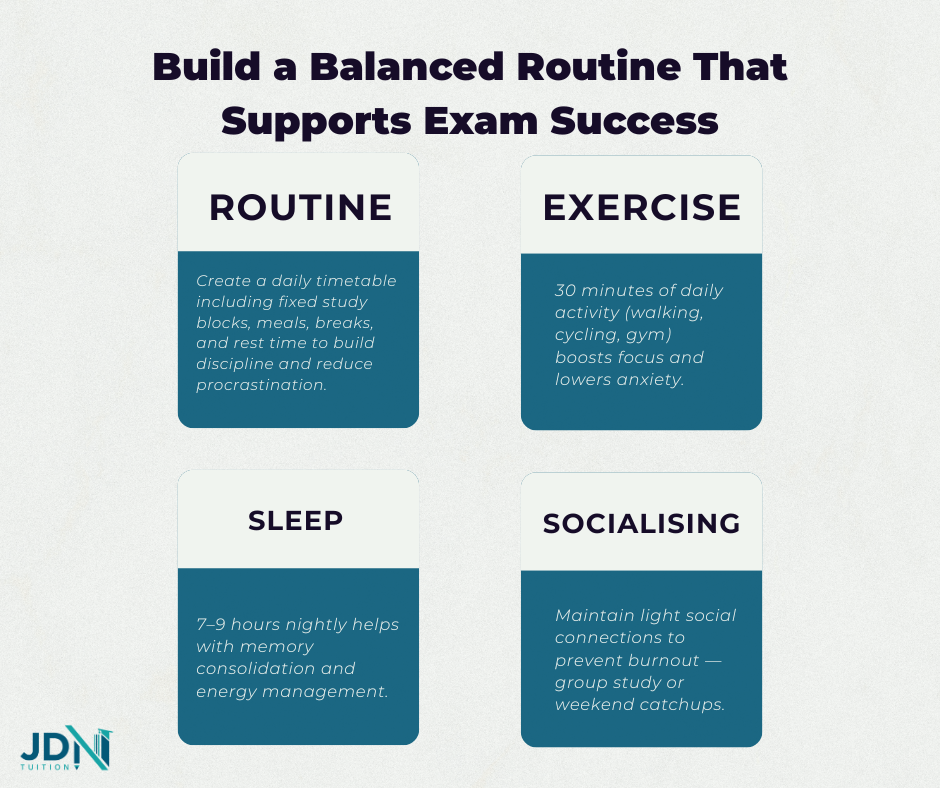
- Routine
- Exercise
- Sleep
- Family
- Socialising
-
Routine
Having a solid and planned-out routine set up is important if you want to ace your VCE exams. Keep the VCE exam timetable in mind and plan out how much time you have for extracurricular activities. A regular routine helps you keep on track and makes it easier for you to hit deadlines without stress. In addition to this, a solid routine will also help combat procrastination. Make sure sleep and relaxation get equal importance in your timetable as your study time. Acting on useful time management tips can help students with their exam preparation.
-
Exercise
Exercise plays a very important role in VCE exam preparation because physical activity helps strengthen both physical and mental health. Why is regular physical activity so important? Regular exercise helps improve concentration, minimize stress, and enhance memory retention. All of these factors are crucial for handling intense study demands for the VCE exam. Students who are engaged in regular physical activity while following their VCE study timetable are more likely to avoid burnout and maintain energy levels throughout that entire journey. Therefore, with the right balance of physical activity with study sessions, students stay motivated and manage their exam anxiety better.
-
Sleep
Why does everyone keep talking about 8 hours of daily sleep? Here is your answer. Adequate sleep is equally important for VCE exam preparation as studying. Because it directly impacts a student’s ability to concentrate, memorize, and problem-solving skills. According to scientific research, regular sleep patterns aid learning, enabling students to retain information better and recall concepts presented in VCE study designs. We understand that it can be tempting to pull all-nighters and cram as much information into your brain before your exam, and stuff like that. However, this kind of unhealthy thing can be counterproductive for you. Without proper rest, students can experience fatigue, reduced focus, and heightened stress, which can undermine months of VCE preparation. As a result, valuing sleep as much as revisions can help students improve performance and approach their VCE exams with clarity and confidence. Sleep improves recall and focus more than cramming.
-
Family
It is very important to communicate with your family in this crucial time when your exams are approaching. Family support plays an important role in the VCE exam preparation, offering both emotional support and practical assistance. A supportive family environment significantly helps students stay motivated, focused, and stress-free while working through the demanding VCE syllabus. A supportive family helps their child by creating a peaceful study space, building a healthy routine, and helping them stick to a daily study timetable. Small actions like preparing healthy meals, providing positive support, and understanding the pressure of VCE exams can make a huge difference. The support of the family can be invaluable for students as they go through this difficult and stressful time of preparing for one of the most decisive exams. Hence, you can say that strong family support makes students better equipped to handle challenges and achieve success in VCE exams. Parents can also explore JDN Tuition’s services to understand how and why we keep families and parents updated about their kids’ progress.
-
Socialising
Socialising with your friends is very important, and make sure in this challenging time you still take out time to hang out with them. Remember, you and your friends are going through the same thing; you can help each other better than anyone else. A group study session with your friends is also a good way to review and compare notes, and ask each other questions about different VCE subjects. Additionally, studying with your group of friends allows you to grasp concepts, solve practice questions, and share problem-solving skills. Socializing with your circle can also help introduce new techniques, such as the active recall study method, where you test each other to strengthen your understanding of topics. Along with this, studying with friends will also keep you all on track, as these group study sessions can help keep you accountable. Concludingly, balancing study with healthy social time ensures students stay energized and positive as their VCE exams approach.
Group accountability helps students work together toward shared goals and hold each other responsible for staying on track. It helps boost productivity during VCE preparation by creating a sense of commitment, motivation, and consistency. Therefore, when students regularly check in, share progress, and support one another, they’re more likely to stay focused, manage time effectively, and overcome procrastination.
How to Prepare to Ace Your VCE Exams? A Step-by-Step Guide
As mentioned earlier, students need to understand that VCE exams are more than just a sprint; it is more like a marathon. Even if you’re just starting to study, you still need a solid plan and VCE exam timetable to help you ace your exam. Here is your step-by-step guide on how you can prepare for your VCE exams that are just around the corner.
1- Craft a Structured Study Plan
Creating a study plan that actually works for you includes several things, like defining clear goals, creating a suitable VCE exam timetable, and identifying important concepts and topics. Start your preparation by setting up your goals, as clear goals act as a compass, ensuring your time is spent wisely. In addition to this, ask yourself questions like “Which subjects need more concentration? Or what are my weak points that I need to work on?” This approach will bring you clarity and help you build personalized learning plans tailored to your specific VCE courses.
Then comes the next step of designing a timetable. A well-designed timetable tends to transform vague ideas and intentions into meaningful actions. Break it down with your daily, weekly, and monthly goals. For instance, daily you complete a topic or a chapter and solve its practice questions, and every week, you revise the key areas and concepts. Lastly, at the end of the month, take a full practice exam created on the pattern of your VCE exam.
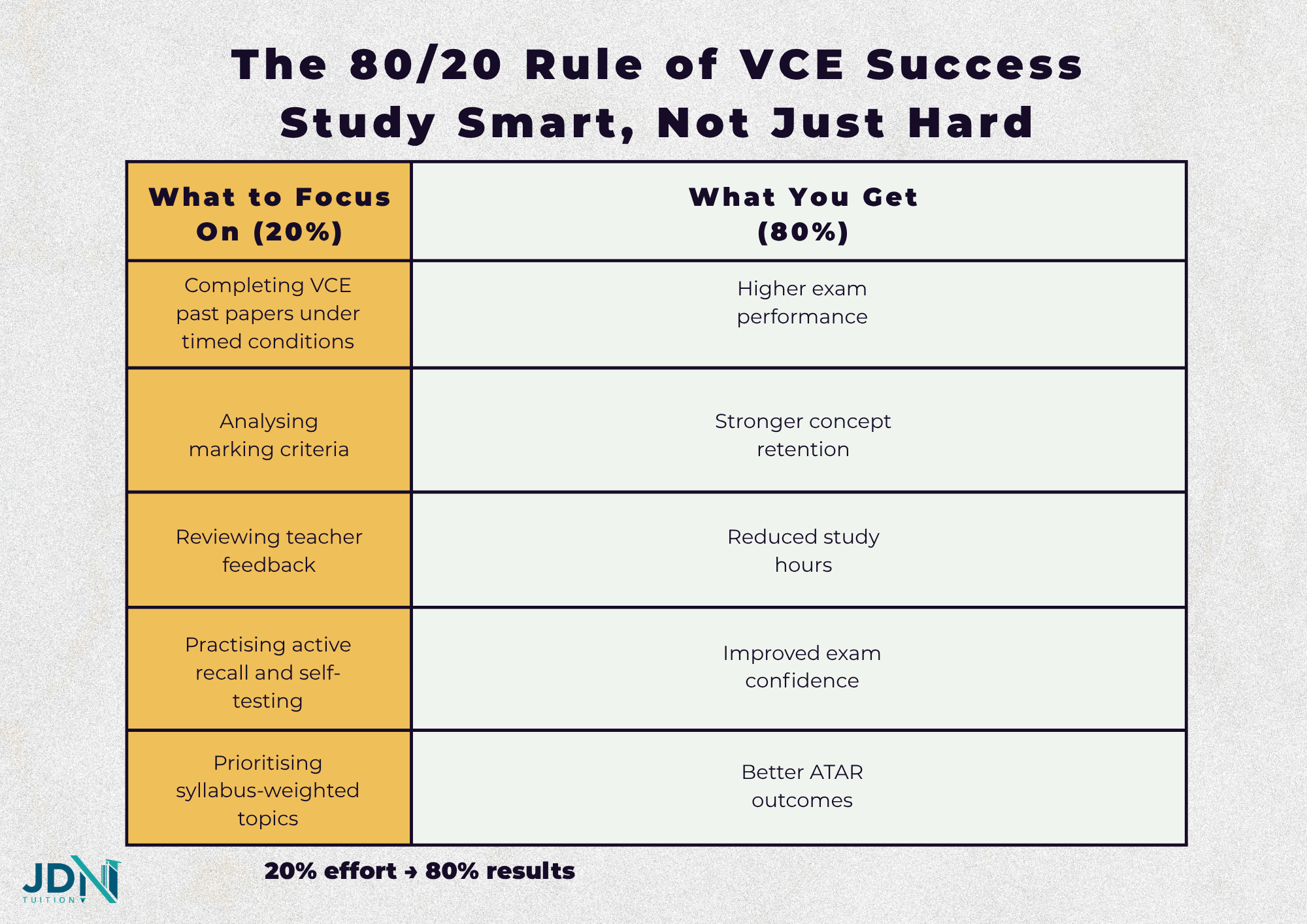
At the end, try to apply the Pareto principle effectively. Filter your most important and high-yielding 20% topics, which will contribute to 80% of your results.
2- Creating Subject-Specific Strategies
Every VCE subject requires a slightly different preparation approach, and building a tailored study plan for each subject makes a difference. For example, for the English subject, consistent essay writing under timed conditions helps with clarity, confidence, and argument development. For Mathematics, you can take help from past exams, and by keeping the formula sheet handy. In the Mathematics exam specifically, students should put effort into learning working steps to gain partial credits as well.
For Science subjects, like Biology, Chemistry, and Physics, practicing diagrams and using flashcards can help strengthen the understanding of complex topics. Additionally, through mind-mapping and creating timelines and flowcharts, students can benefit big time in Humanities.
Also, when it comes to Languages, constant practice in writing, reading, and grammar helps students build fluency. Therefore, through all VCE subjects, VCE tutors, and past papers can help provide valuable guidance and insights into exam patterns and timing. So, do not hesitate to ask your teachers and keep solving past papers for the best kind of VCE exam timetable.
A parent came to us explaining their child’s struggle with the VCE exam preparation. At JDN Tuition, our team of skilled teachers helped the student significantly improve in the struggling subjects, resulting in satisfied parents and a well-prepared and confident student for exams. To have more insights and look into what our clients have to say on our website.
3- Active Learning Methods
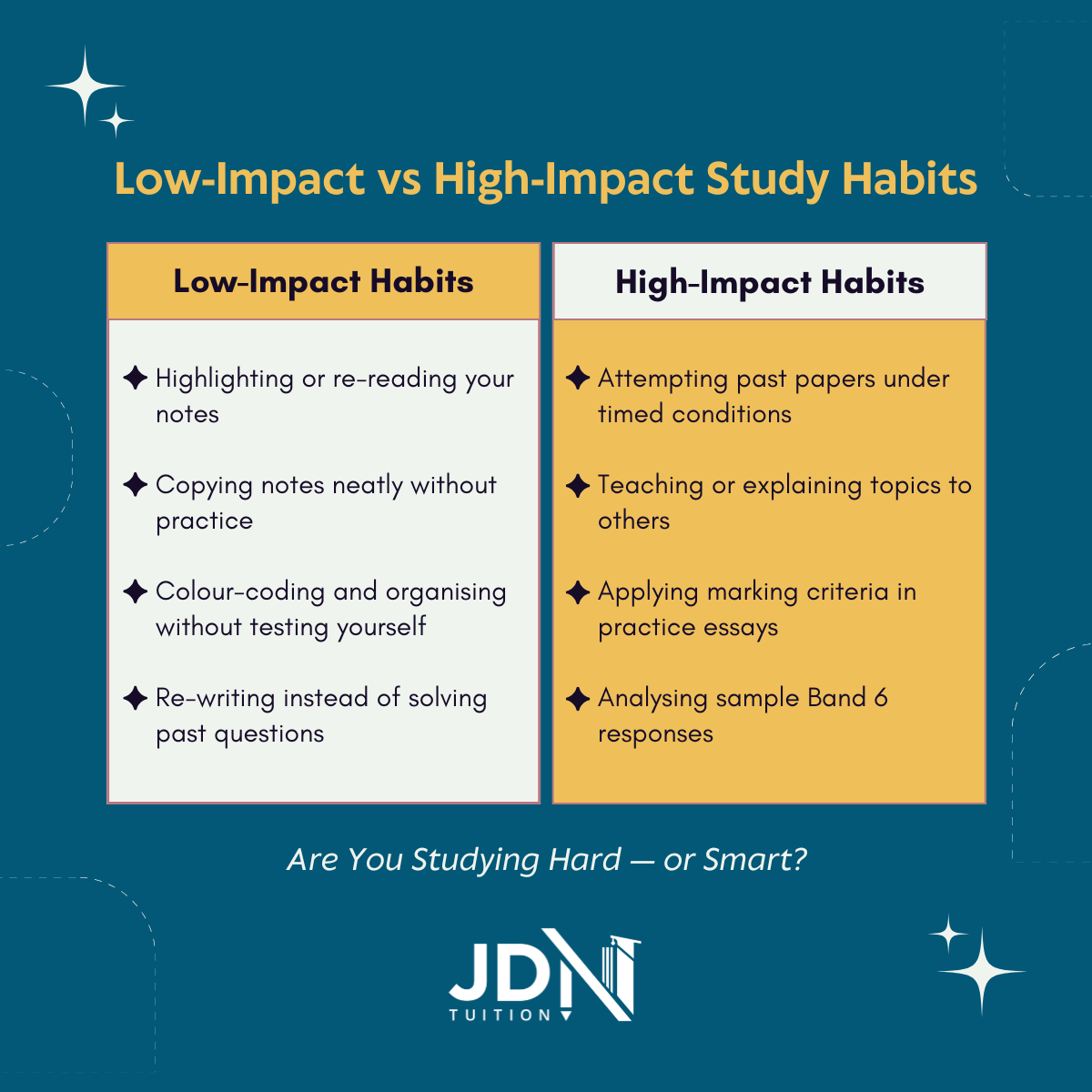
Active learning methods are proven techniques where you get your mind to retrieve information that improves and strengthens your memory more than re-reading the same information repetitively. Rote memorization and cramming the information are rarely effective. Therefore, using active learning techniques such as teaching others, mind mapping, self-testing, and the Pomodoro technique can help.
Teaching or explaining concepts to your friends can help reinforce knowledge. Through mind mapping, students can visually connect ideas, which helps strengthen memory. You can self-test by closing your notes and trying to recall the concepts. Also, the Pomodoro technique is when you study or work for 25 minutes, rest for 5 minutes, and repeat. In addition to this, a spaced repetition schedule also significantly helps students retain information. It involves reviewing specific information multiple times and increasing the time in between reviews.
4- Time Management to Avoid Procrastination
Time is a limited resource, and managing it is crucial for success. To combat procrastination, fragment big tasks into smaller, manageable actions and use different tools like to-do lists or applications. Notion and Trello are some apps to help you stay organized. Going through VCE study material in small chunks and attempting the VCE practice exam can help manage concentration while tracking progress.
Also, rewarding yourself with some fun moments after hitting a milestone can help you stay motivated. Avoid constant exhausting marathon sessions and instead, mix in breaks and fun times to stay energized for your VCE exams.
Always remember that consistency is the key to success.
5- Build the Exam-Day Confidence
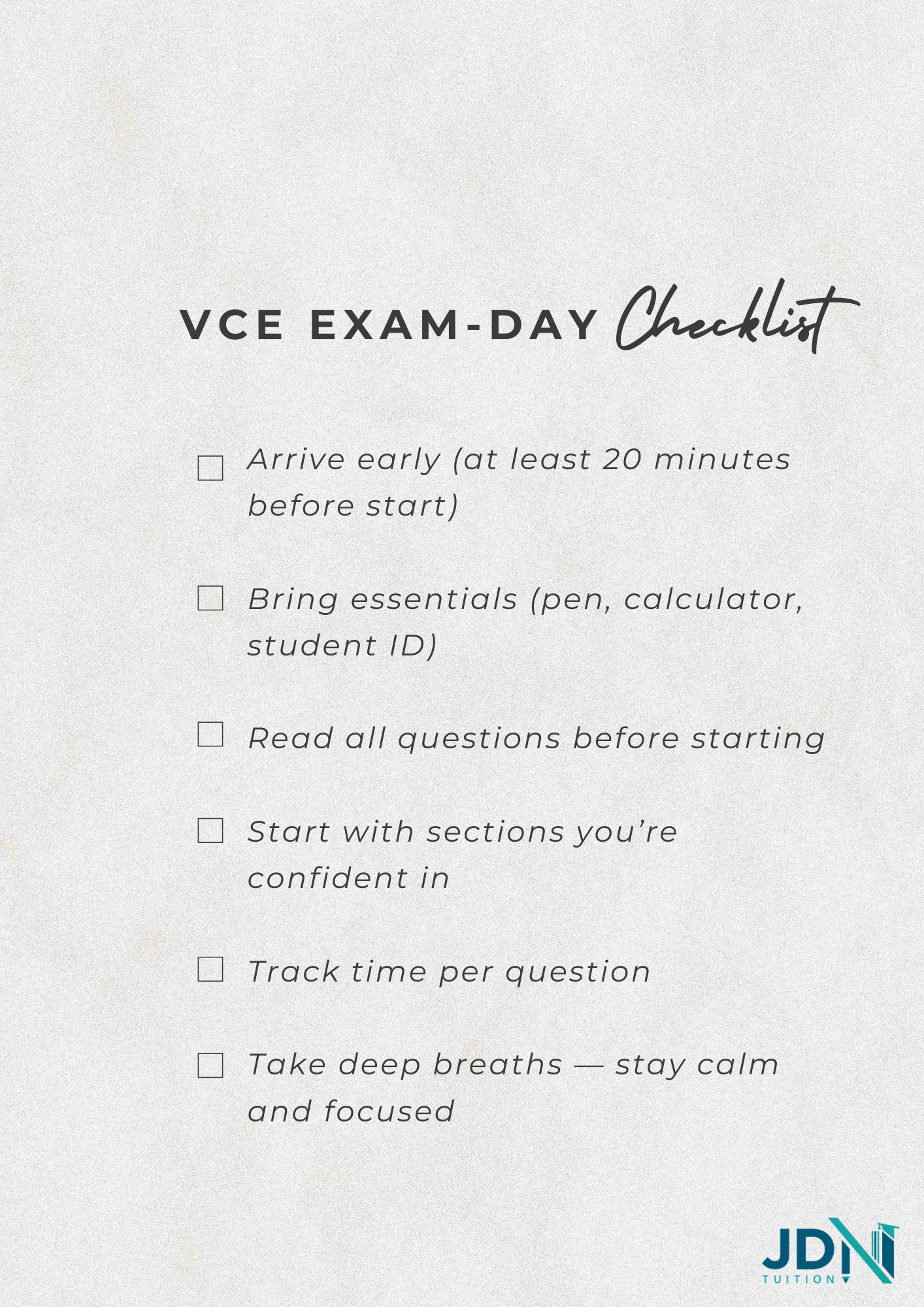
While attempting VCE past papers, practice exam-day conditions. For example, set a timer and avoid distractions like phones and other people. This will build familiarity, so that the actual exam day feels like a rehearsed performance. In addition, students should build exam strategies like reading the entire paper first and prioritizing the questions they’re the most confident about.
Students should manage their time wisely and stay calm during the exam. It will help them perform better rather than in a panicked state of mind.
Quick Exam Day Checklist:
- Admit card & ID
- Pens, pencils (add backups as well)
- Water bottle
- Watch
- Snack
- Positive mindset
Always remember, practice makes a man perfect.
Mental Health Tips for Students Taking VCE
Mental health is one of the most overlooked aspects of the VCE exam preparation. Exam stress, peer pressure, and high expectations result in anxiety and burnout. Here are some of the mental health tips for students going to take VCE;
- Recognize your stress signs, such as trouble sleeping, feeling anxious, and loss of concentration, before they can harm you.
- Practice mindfulness, meditation, and other stress management techniques, like deep breaths and exercise, to reduce anxiety.
- Don’t let go of healthy lifestyle choices, like eating healthy meals, sleeping for 7 to 8 hours, and staying hydrated. A healthy body keeps a healthy mind.
- Seek help where needed. Share your struggles with your family, friends, and tutors, and ask for their help. Remember, seeking help is not a weakness; it’s also a part of resilience.
Resilience is built, not born.
Conclusion: VCE Exam Timetable and How to Prepare for VCE
Preparing for the VCE exam is not just about cramming information and facts; It’s about developing skills that serve you throughout your life. It is also about building discipline, resilience, and time management; all of these are life skills, not just exam skills.
Approach the VCE exam timetable with balance and structured study strategies, but also make sure to prioritize your mental health on this journey. With the help of the right strategies, you’ll not only ace VCE, you’ll also come out stronger and more resilient.
JDN Tuition: Your Go-to Partner for the VCE preparation
At JDN Tuition, we help students ace their VCE exams with personalized support that adapts to each student’s unique pace. Our expert teachers with their versatile teaching styles help simplify complex concepts and strengthen exam techniques needed to score well.
From English essays to complex Math problems to difficult Science concepts, we ensure students are guided step-by-step at every level.
If you want your VCE exam preparation to be less stressful and more impactful, contact us today. Become a part of our family, where we empower students to give their best when it matters the most. To have insights into different topics, visit our blog page.
Stay connected with JDN Tuition—follow us on Facebook, Instagram, and LinkedIn for tips, updates, and reviews.
Boost Confidence. Improve Results. START TODAY.
📞 Book a FREE Consultation Call: (02) 7257 0299
📧 Email us: contact@jdntuition.com.au
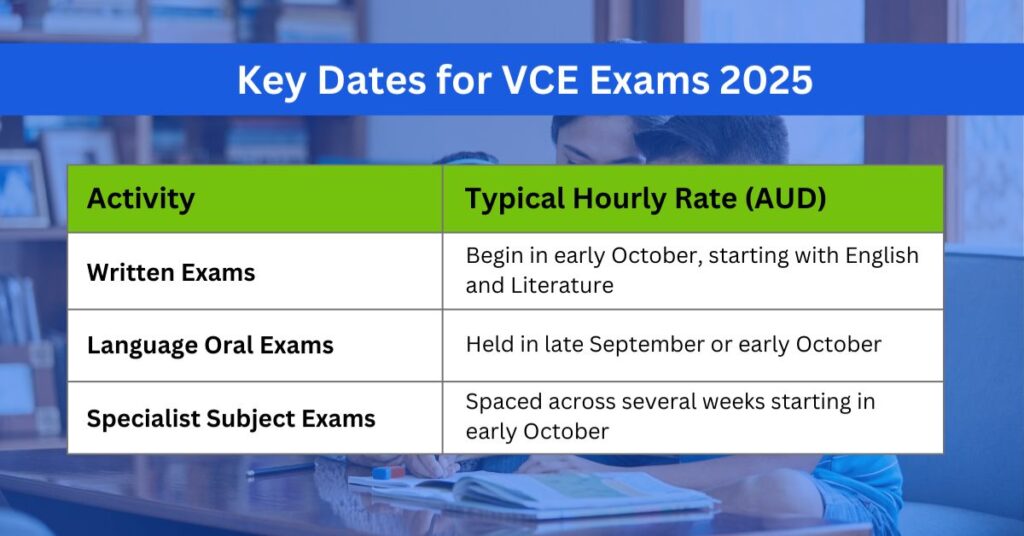
Here are the official websites to look for key dates and exam schedules;
https://kisacademics.com/blog/vce-exam-timetable-2025-key-dates/
https://www.vcaa.vic.edu.au/administration/key-dates/vce-examination-timetable
FAQs
What is the purpose of VCE?
The Victorian Certificate of Education (VCE) is a key assessment for secondary school students in Australia. The result of VCE contributes to ATAR, which is assessed for university entry. Its purpose is to evaluate students’ knowledge and skills against their chosen subjects.
What is the difference between VCE and IB?
The VCE is a state-based exam in Victoria, Australia, offering flexible choices for students and contributing to the ATAR for university admission. The International Baccalaureate (IB) is a globally recognized program with a fixed structure. It highlights the core curriculum, international perspectives, and critical thinking. While VCE is unique to Australian pathways, IB prepares students for both local and international opportunities.
What subjects scale high in VCE?
In the VCE exam, subjects like Specialist Mathematics, Physics, Chemistry, and languages like Latin are considered high-scale subjects due to their difficulty. Scaling helps adjust scores so that students don’t get disadvantaged in difficult subjects. High-scale subjects can boost a student’s ATAR if they score well.